










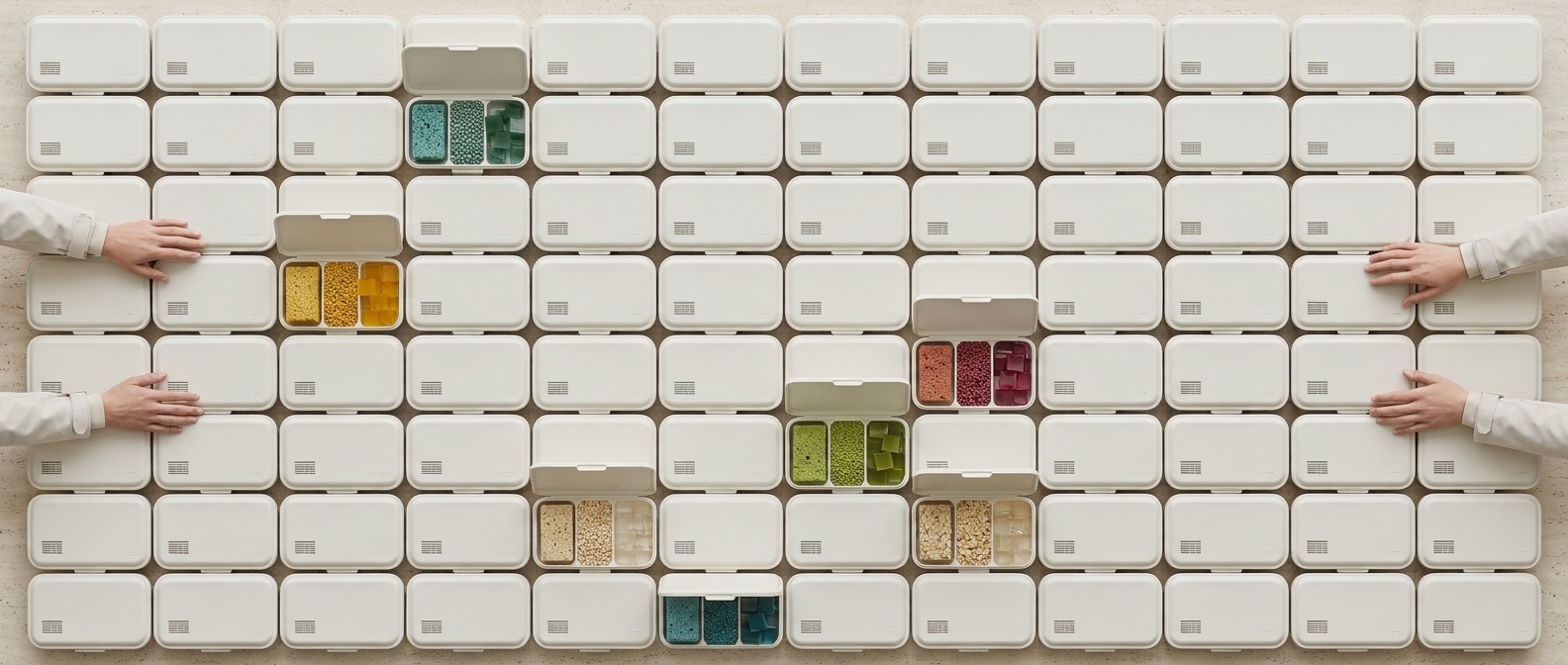
ZERO-COST NUTRITION / 2050
Food as infrastructure.
Three free meals a day for everyone on Earth.
Case 01 / Industrial Design / 2050 concept
In 2050, no one goes hungry.
Industrial food production supplies regional reserves. Neighborhood service points and mobile delivery make a basic meal available to everyone.
Explore the system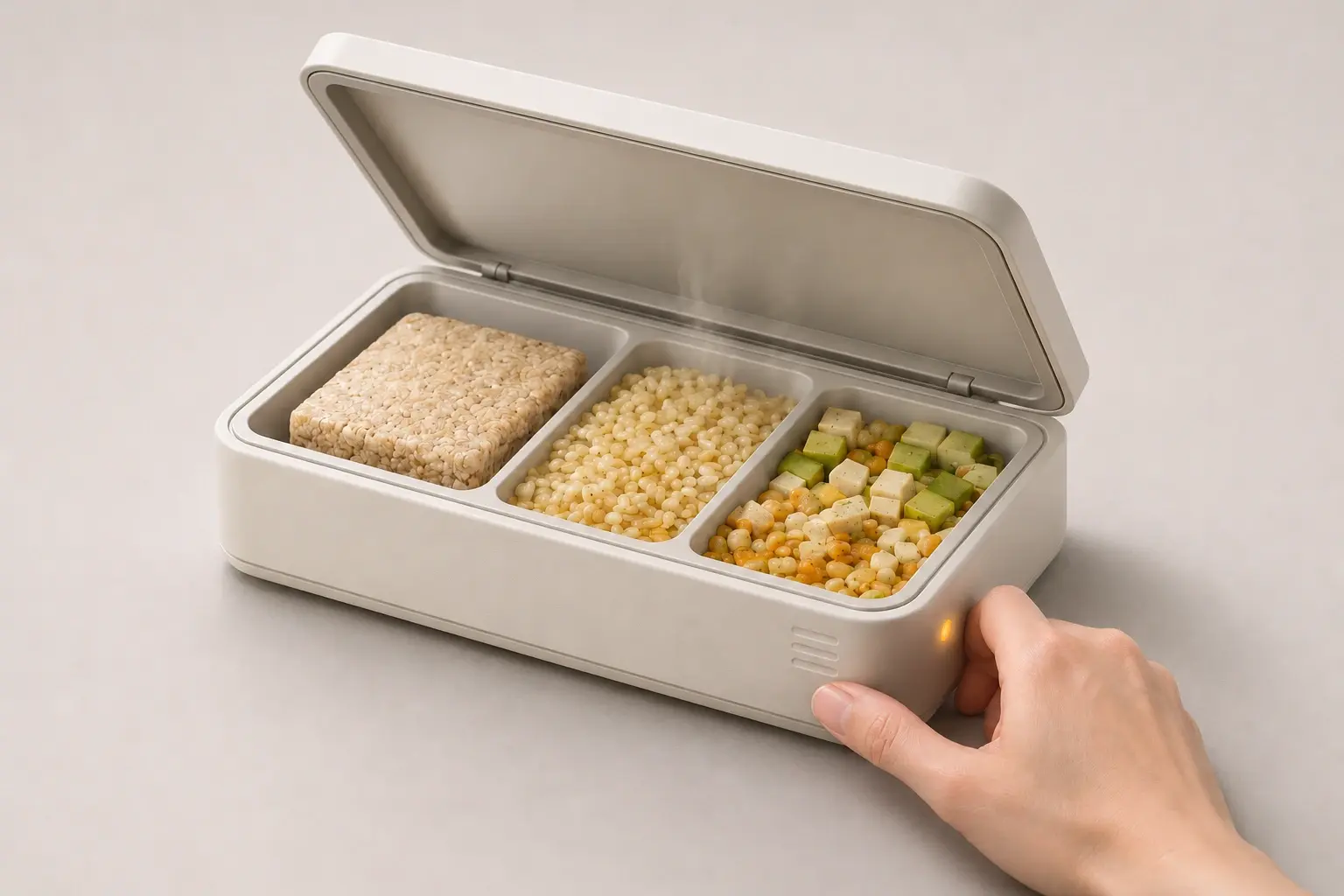
Storage / Inventory
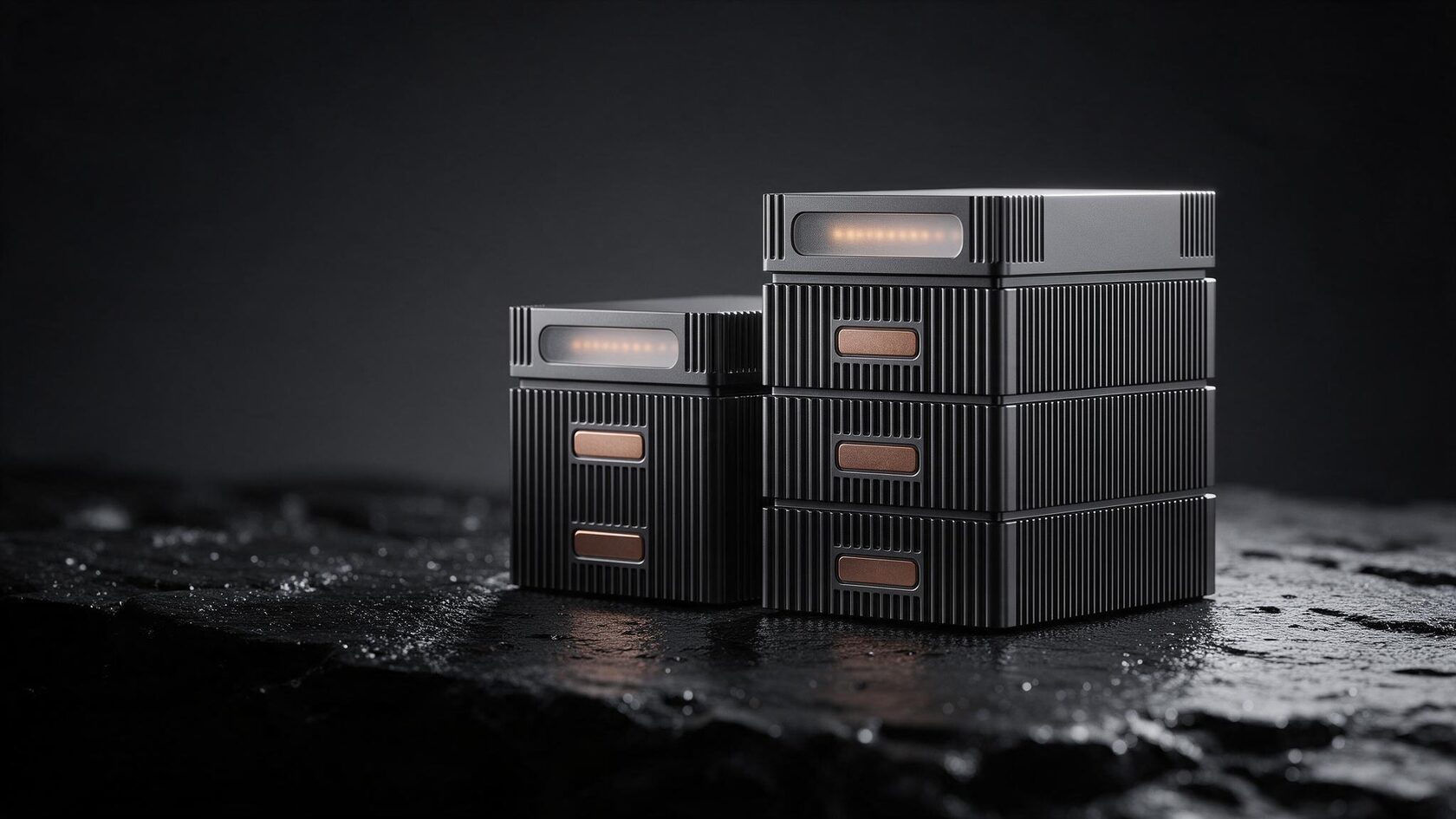
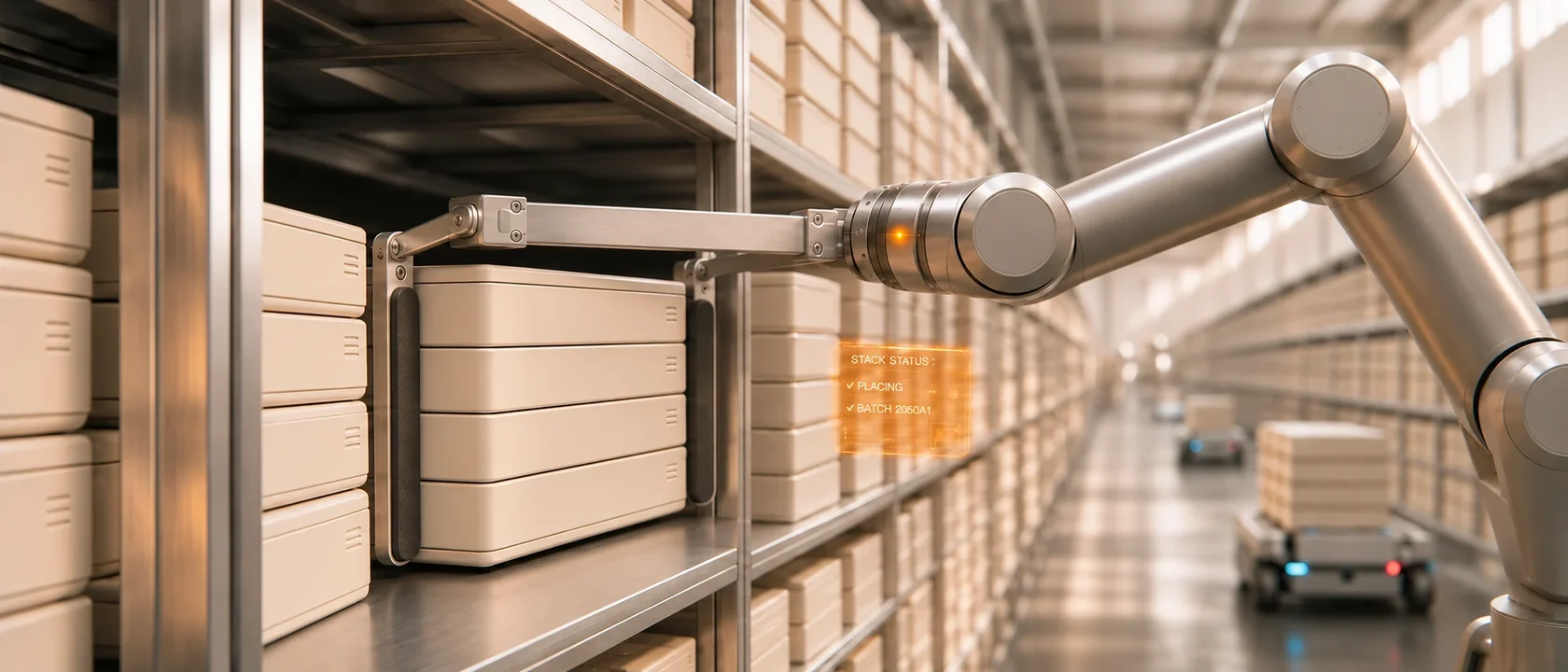
Food Library 2050.
Industrial production supplies regional reserves. Robots identify each sealed meal by its 2050 Code, then dispatch it for local pickup or mobile delivery.
Meal record / Scanned from the cassette
Lunch 07
Lentils, barley & spinach · 1 portion / 449 g
605 kcal
93% of a 650 kcal meal target
Illustrative meal profile
- Protein
- 23.8 g
- Carbs
- 81.8 g
- Fat
- 22.6 g
- Fiber
- 23.1 g
- Sodium
- 383 mg
Full nutrition and batch record
- Total sugars
- 4.4 g
- Added sugars
- 0 g
- Saturated fat
- 3.2 g
- Calcium
- 178 mg
- Iron
- 11.9 mg
- Potassium
- 1,293 mg
- Magnesium
- 182 mg
- Folate
- 518 µg DFE
- Vitamin D
- 0 µg
Lentils 200 g, barley 135 g, spinach 92 g, olive oil 21 g, salt 0.8 g.
Estimates from USDA FoodData Central
Contains gluten (barley)
Lot 071A / Use by 18 Jun 2050
From rack to hand.
01 Store
Four sealed cassettes per stack.
02 Retrieve
Side jaws lift the four cassettes together.
03 Identify
The reader scans the 2050 Code to retrieve the meal record.
04 Dispatch
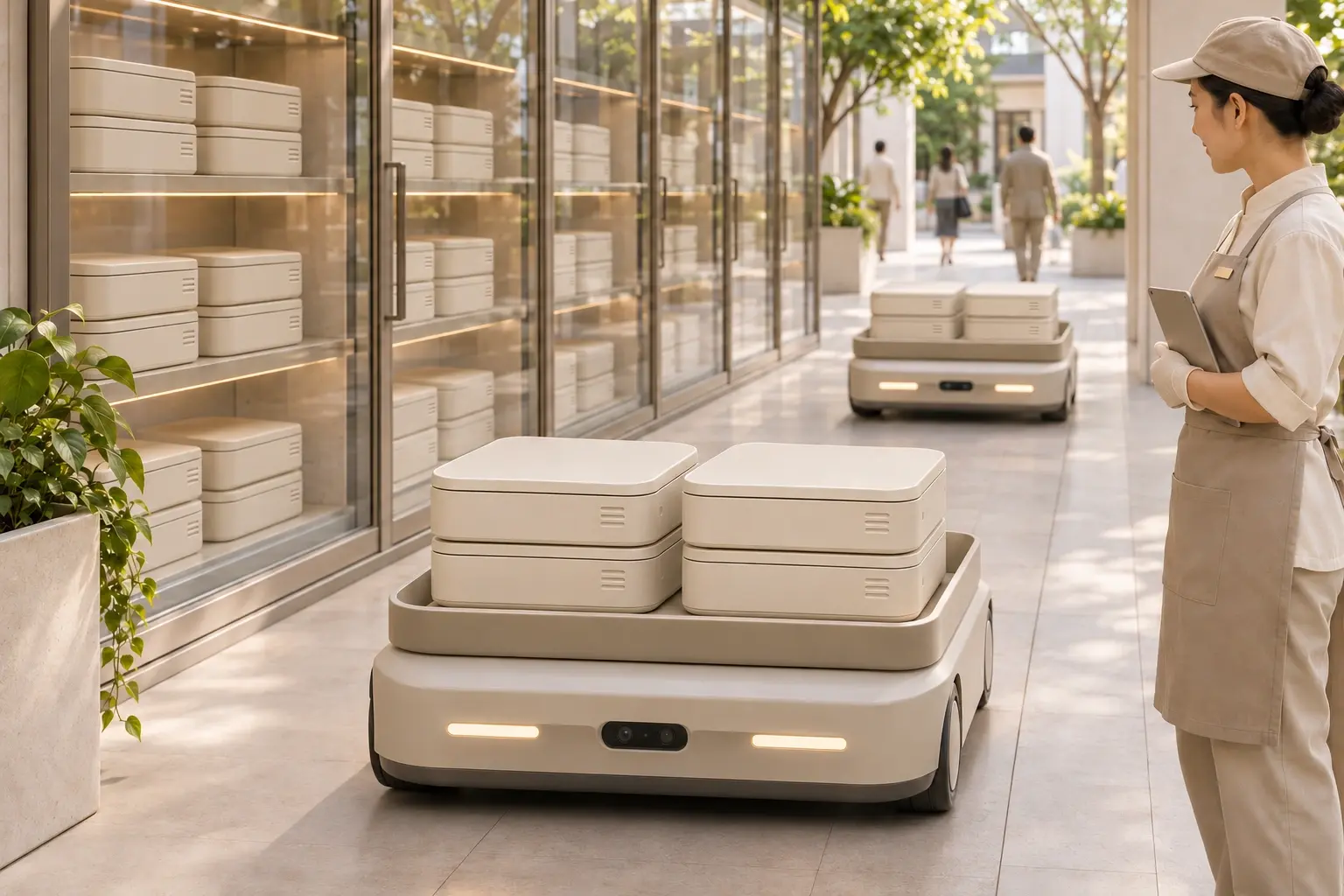
An aisle robot moves the stack to the loading bay.
05 Mobile delivery
A mobile unit brings meals to local pickup points.
06 Collect
The recipient lifts one cassette from the vehicle’s tray.
Supply network
A meal within reach.
The network brings publicly funded meals to transit stops, community kitchens, and mobile pickup points. A person can collect a portion without a phone or payment card.

- 01 / Make
Industrial production
Food plants process and portion ingredients, then seal them in standardized meal modules.
- 02 / Deliver
Two supply routes
Sealed dry stock travels in reusable crates. Perishable components travel under refrigeration, with a temperature record at handoff.
- 03 / Store
Neighborhood stock
Local kitchens keep a dry reserve and a separate refrigerated cabinet. Lot and use-by labels guide rotation and replenishment.
- 04 / Serve
A meal on demand
Kitchens and mobile services prepare portions close to where people live. Regular service draws down the stock and keeps the reserve in use.
Container / Operating states
One container. One meal.
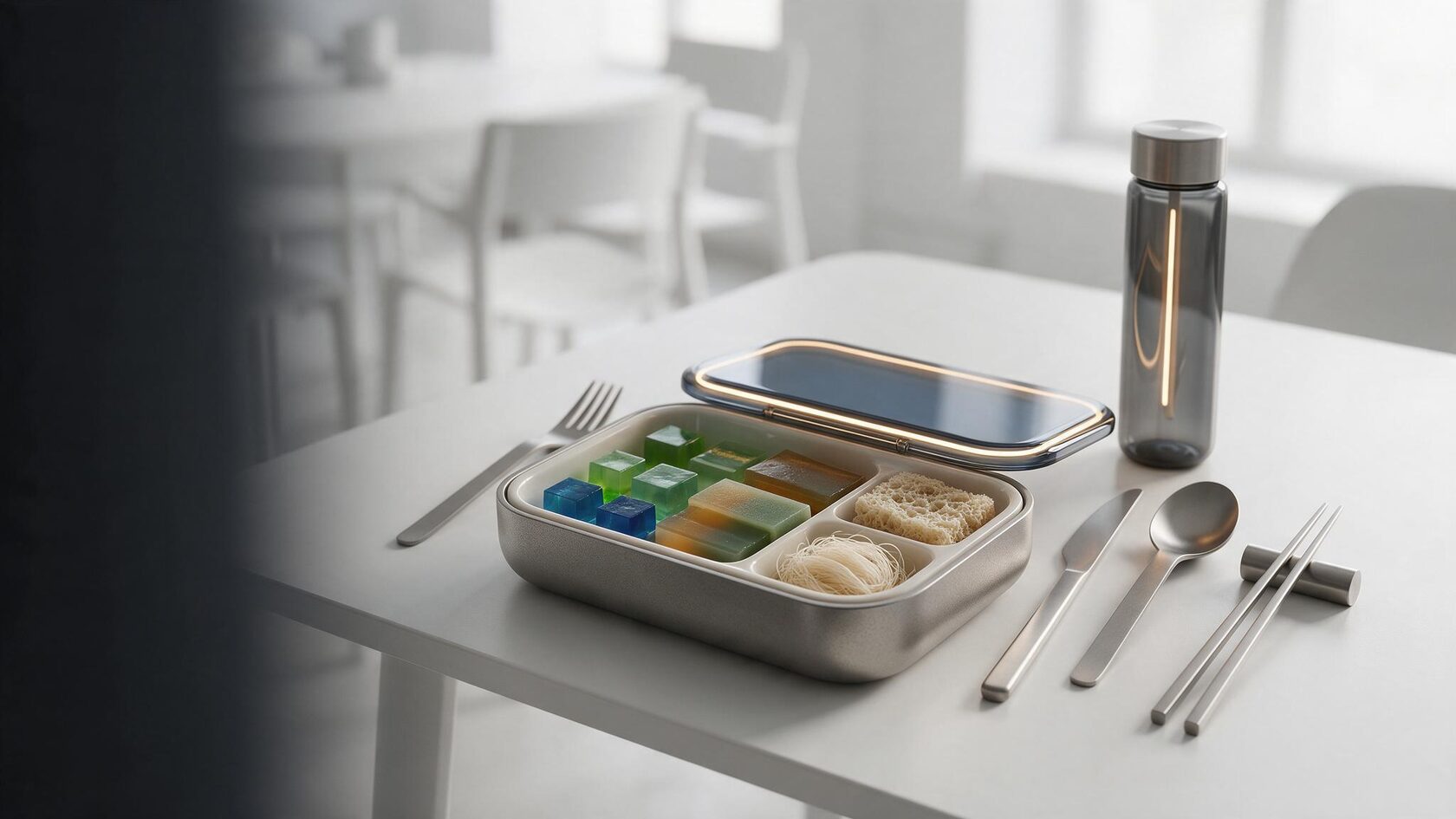
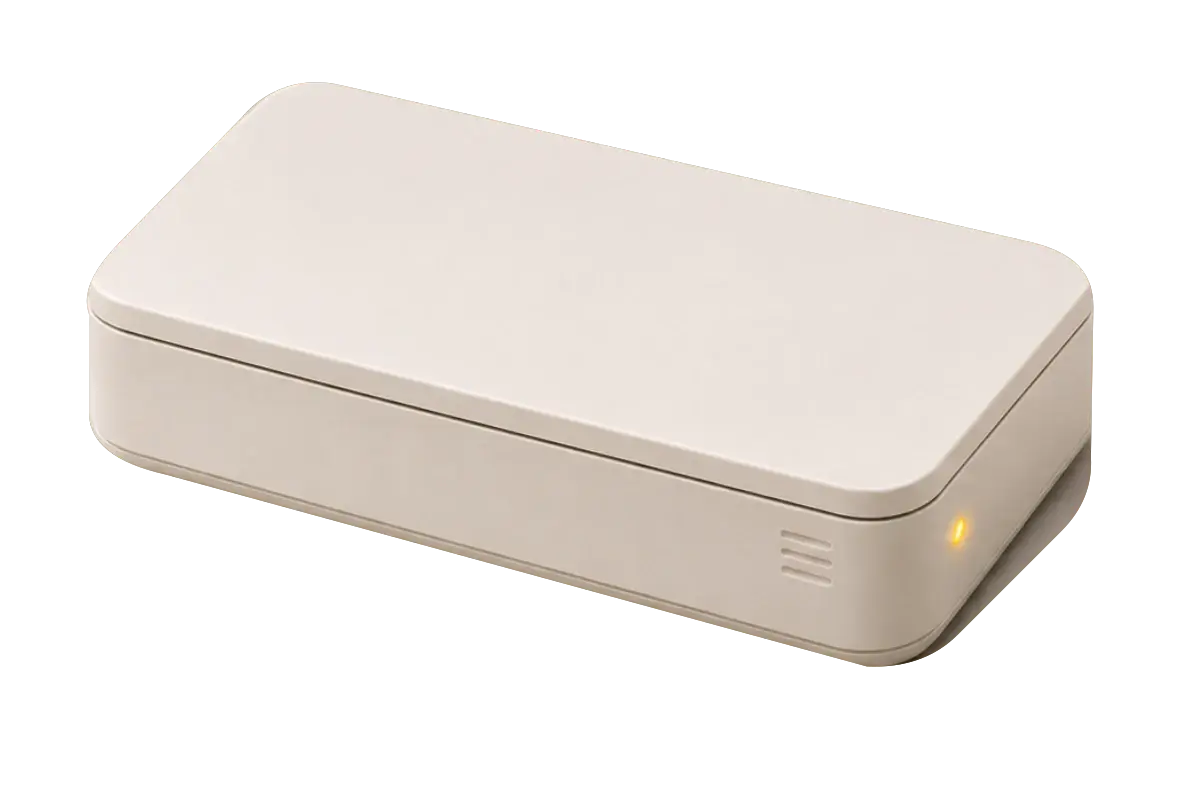
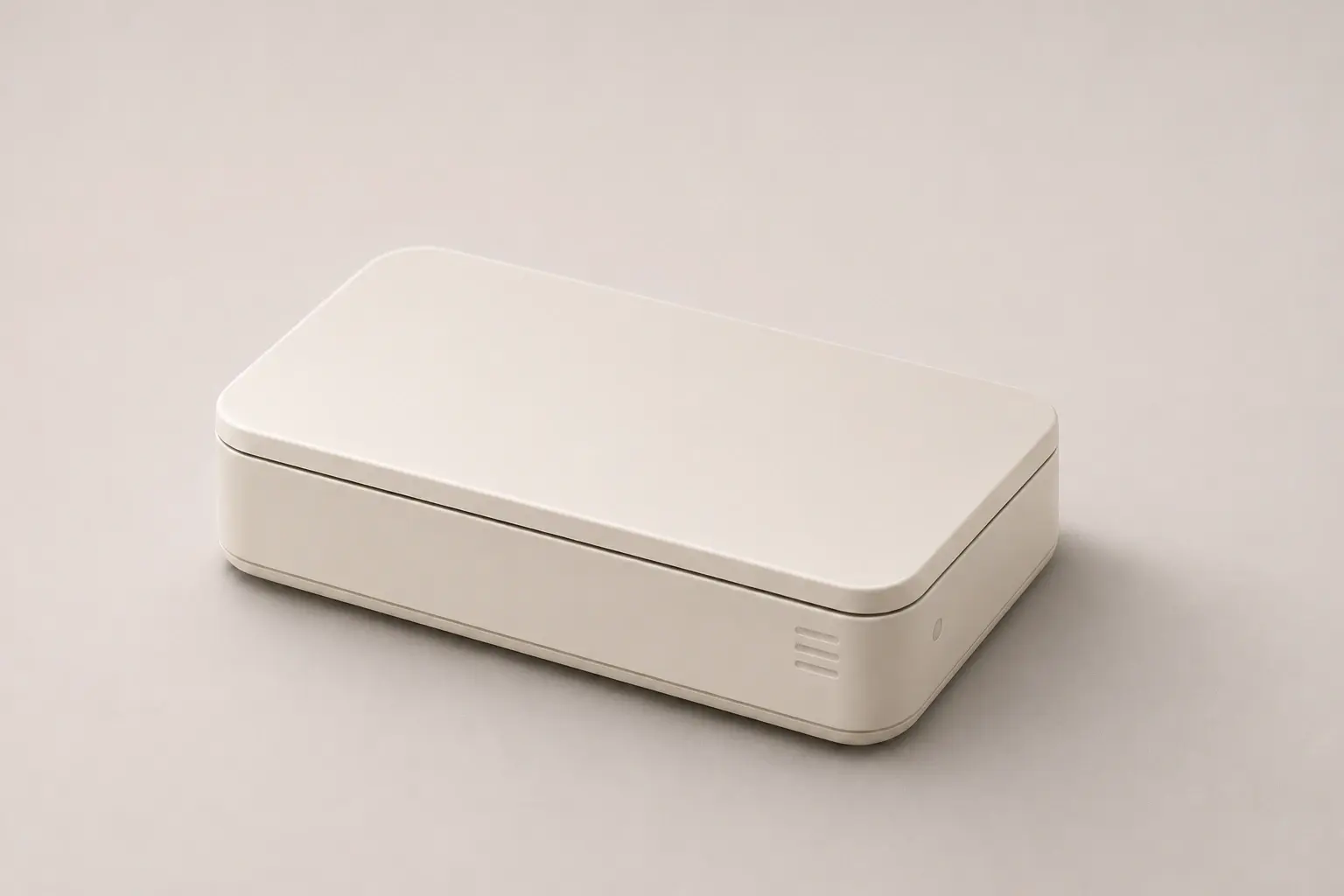
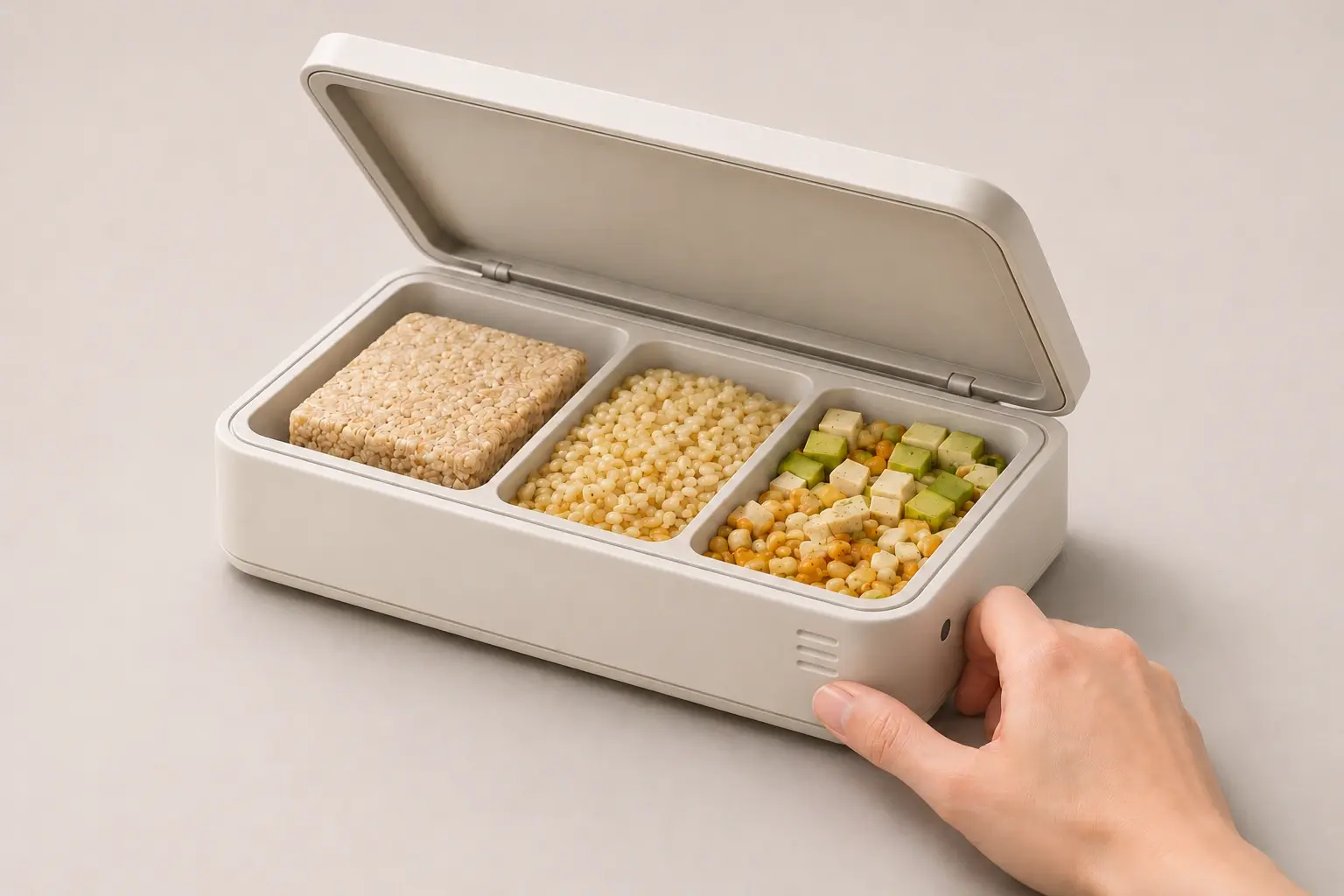
The same three-compartment container moves through cold storage, heating, and service.
- Cooling mode
- Closing the lid switches the container to cooling.
- Three compartments
- The dividers keep the components of one meal separate.
- Built-in heater
- The heater warms the portion directly in the tray used for serving.
Built for reuse.
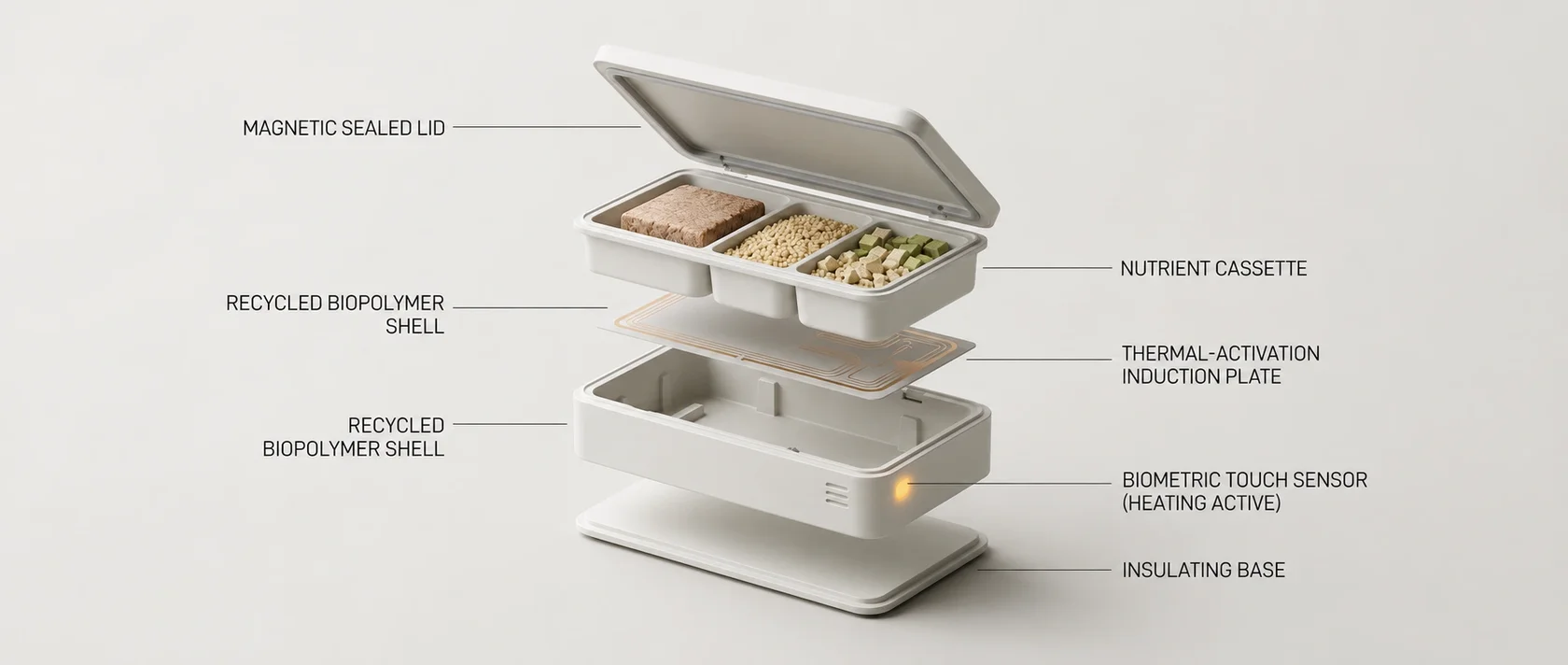
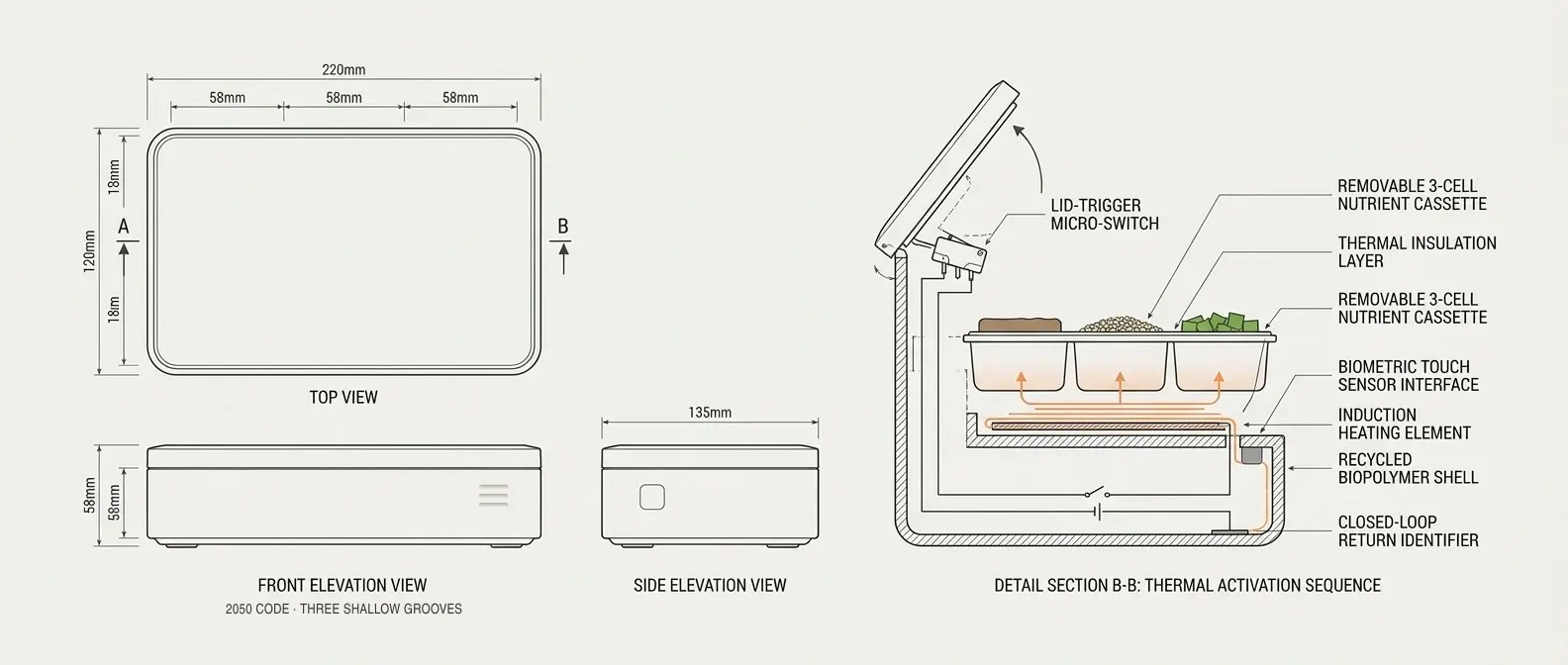
The meal cassette lifts out for washing and refilling. A replaceable seal lets the insulated shell return to service.
Food composition
Every portion has a recipe.
The three compartments let foods with distinct textures share a single tray. Each recipe specifies a nutrient profile for the complete portion.
Calculation per serving
Weigh each ingredient, calculate its nutrient contribution and account for changes during preparation. Divide the final recipe into measured servings.
Portion record · Energy, protein, fats, carbohydrates, fiber, vitamins and minerals. Ingredients and allergens appear with the recipe.
Technology / Preparation
One portion. One cycle.
The container prepares a portion in its front serving well. It doses water for dry recipes and regulates the well’s temperature independently of the reserve.
- 01 / Open
Choose a portion.
Open the lid and load the front well. A dry recipe specifies water mass, temperature and soak time.
- 02 / Prepare
Measure the dose.
For dry recipes, a load cell measures the weight gained as water is added. The pump stops at the recipe’s target mass.
- 03 / Serve
Warm and eat.
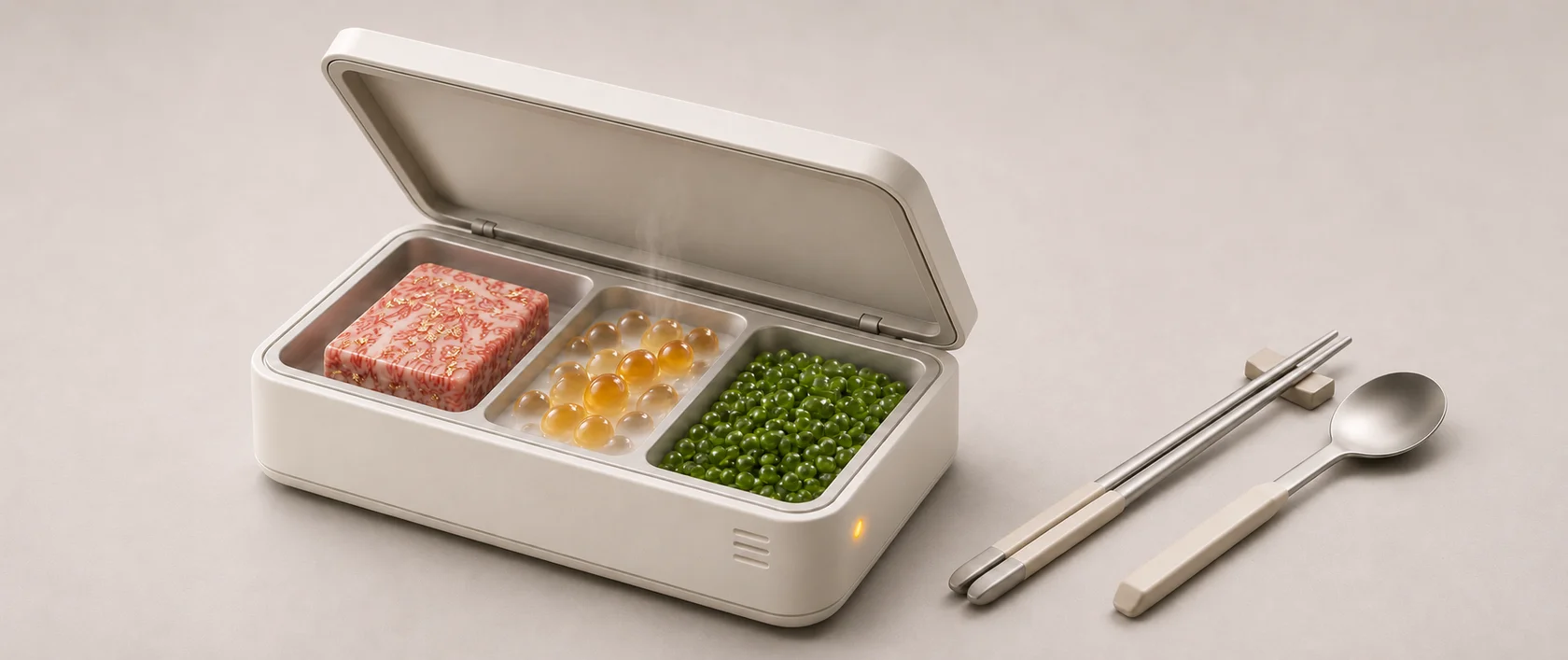
With the lid open, the heater brings the selected portion to serving temperature and holds it there while the person eats from the well.
- 04 / Close
Chill and store.
Closing the lid stops heating and starts active cooling. The closed well holds food under temperature control once it has cooled.
Inside the container
The lid switches the mode.
A hinge sensor signals whether the lid is open or closed. The temperature probe and controller run one mode at a time in the insulated well.
- Open / Warm
- A resistance heater warms the well through its base. An amber indicator on the front signals the serving mode.
- Closed / Chill
- A thermoelectric cooler draws heat through the same plate to a rear heat sink. The controller checks cooling time and temperature before confirming storage.
The tray in section.
In this induction study, the heating plate sits below the removable cassette. A switch at the hinge detects when the lid opens.
Human interface / Ergonomics
Eat from the container.
The low front rim gives the diner direct access to the cassette. The lid opens away from the hands, and an amber light indicates active heating. The cassette serves as the dish and lifts out for washing.
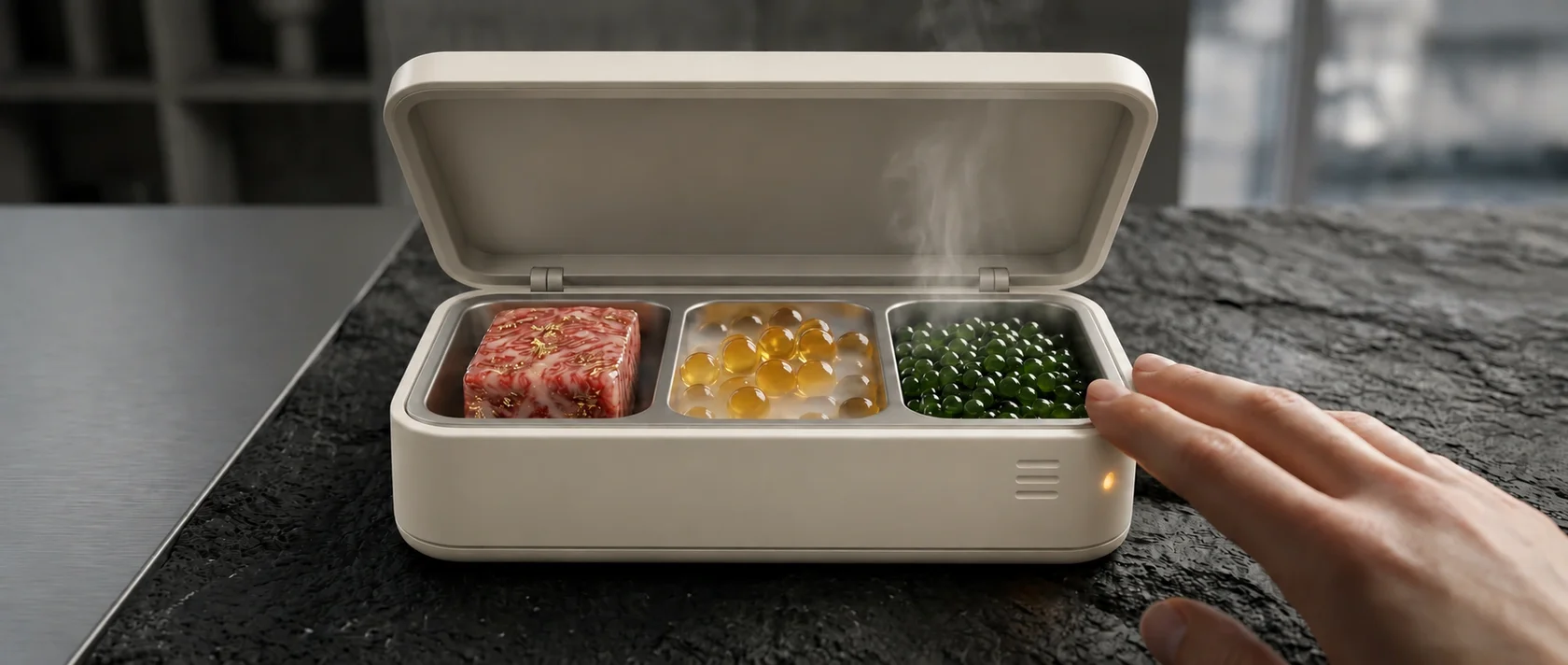
Prototype tests would check dosing, cooling time, temperature uniformity, reach and cleaning.
Reuse / Reverse logistics
Back into circulation.
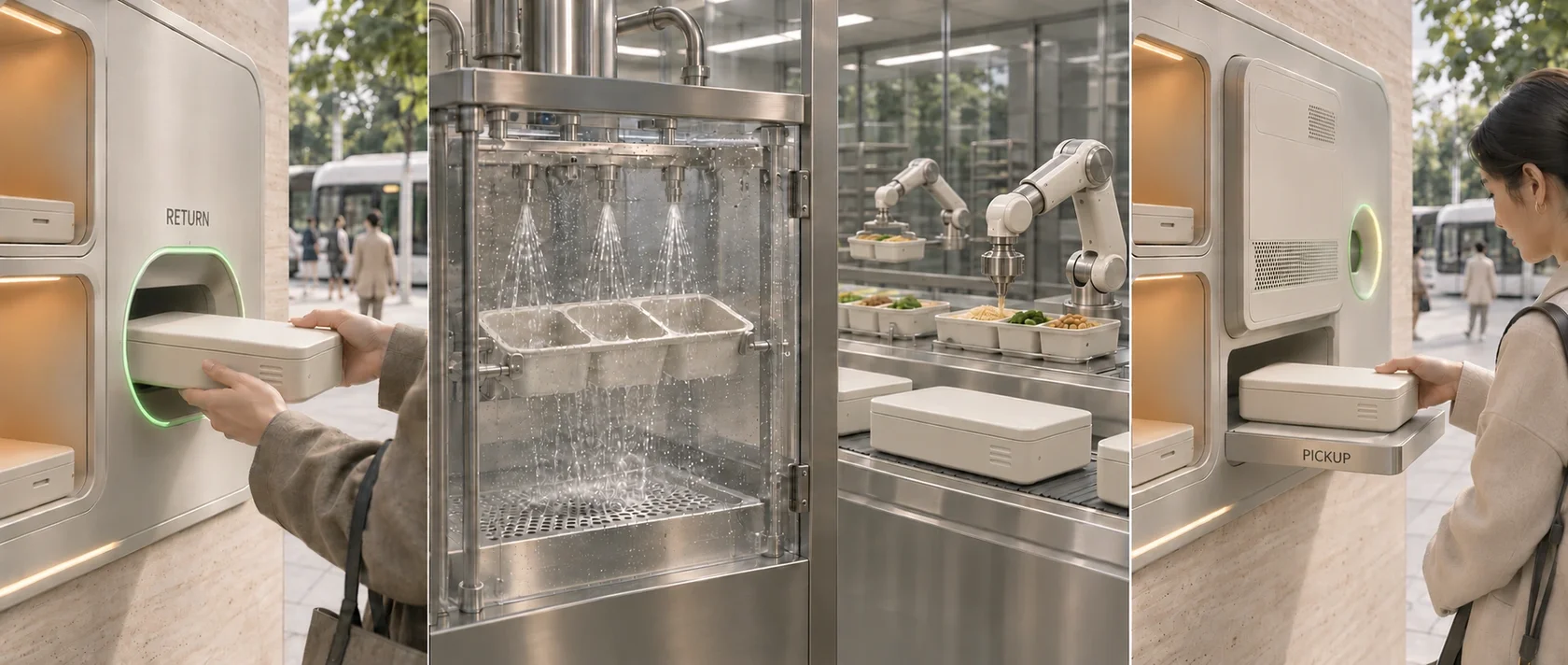
Delivery vehicles collect empty containers from public stations on the return trip. At the food plant, an enclosed washer cleans the removable tray and robots fill it with a new portion. The plant cleans and checks the shell, then sends the sealed container out with the next delivery.
Care, scaled for everyone
From one kitchen
to a shared pantry.
A shared station holds a dry reserve and separate refrigerated stock for a community kitchen, housing complex, or mobile service point.
When a station is unavailable, a community kitchen can prepare the same dry portions with ordinary equipment. A public meal program funds three meals per person per day.
The same format at home.
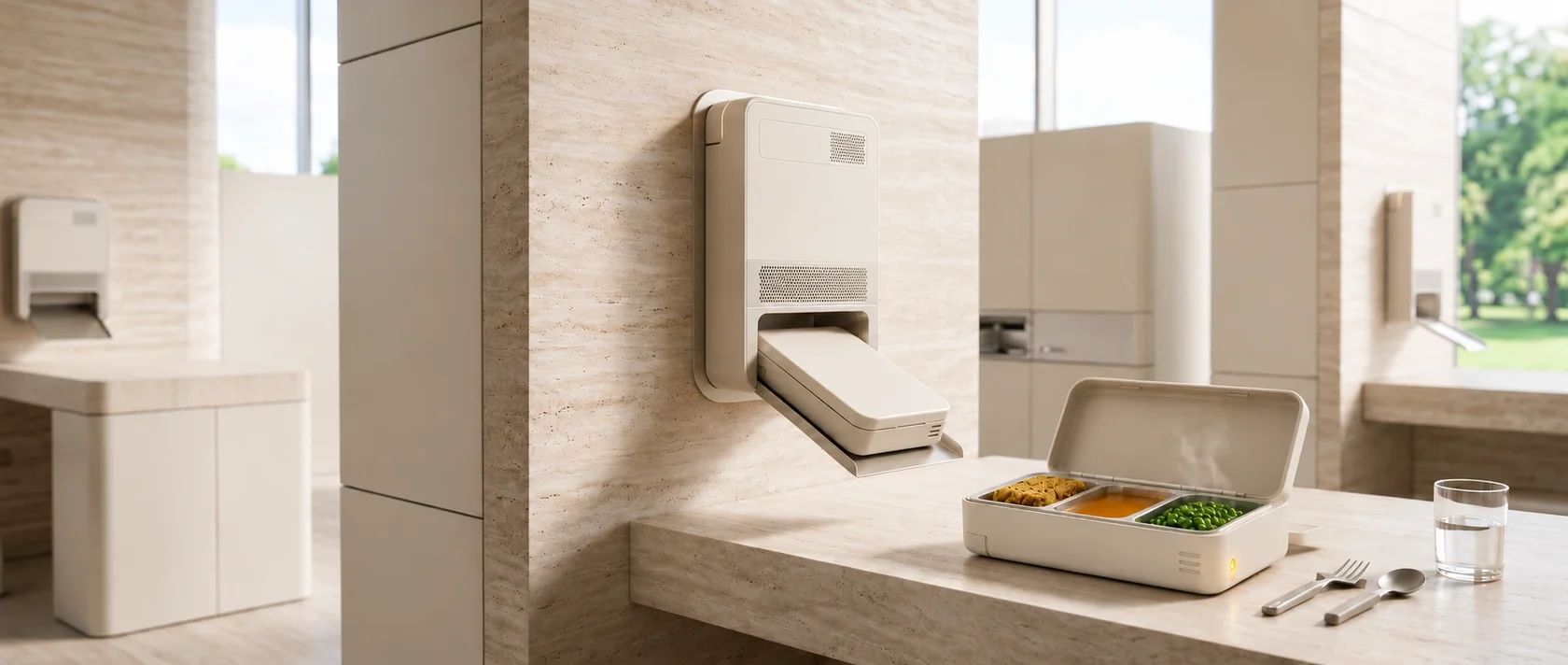
A wall-mounted dispenser issues a single portion in the same reusable cassette. The meal is warmed and served in its tray at the counter.